
GENERAL TRANSLATION
General translations could be described as translations without a stamp. Unlike official translations, general translations do not require a translator’s statement or any other form of certification.
What types of documents fall in this category?
The most common documents I translate without a stamp are:
- archive materials
- old postcards and letters
- hand-written documents
- old registry records (entries in old registers of births, marriages, etc.
- wedding speeches
What is the cost of general translation?
- The cost is usually based on word count. If you send me your source text in a machine‑readable format, the fee will be calculated according to the number of words in your document. Where a word count cannot easily be taken from the source, the word count of the translation will be used instead.
- Other factors such as the complexity, specialist nature, and legibility of the text are also taken into account.
How fast can you supply the translation?
- Delivery times will depend mainly on the length and difficulty of the text and will be agreed upon in advance.
How will you deliver the translation to me?
- General translations are usually sent electronically, most often in .pdf or .doc format by email, WhatsApp or Messenger. Whatever suits the client best.
Translation and Artificial Intelligence
You might be wondering why anyone needs a translation without a stamp, when artificial intelligence seems able to handle everything these days. It is true that AI can do a lot, but from my own experience I know that certain translations still cause it difficulties. Three examples spring to mind immediately when it comes to translation between Czech and English.
AI – Credibility and Authenticity
The first real challenge for artificial intelligence remains translation INTO Czech. Compared with Google Translate, AI is in a completely different league and already just a small step away from perfection — but it’s still not quite there. Translations into Czech often sound unnatural and artificial. If you need to translate a casual email from a friend from English into Czech, it probably doesn’t matter a great deal. But imagine a client asking for a wedding speech in English to be translated so that it makes a Czech grandmother who doesn’t speak a word of English laugh at the wedding. You’ll definitely need a human for that one!
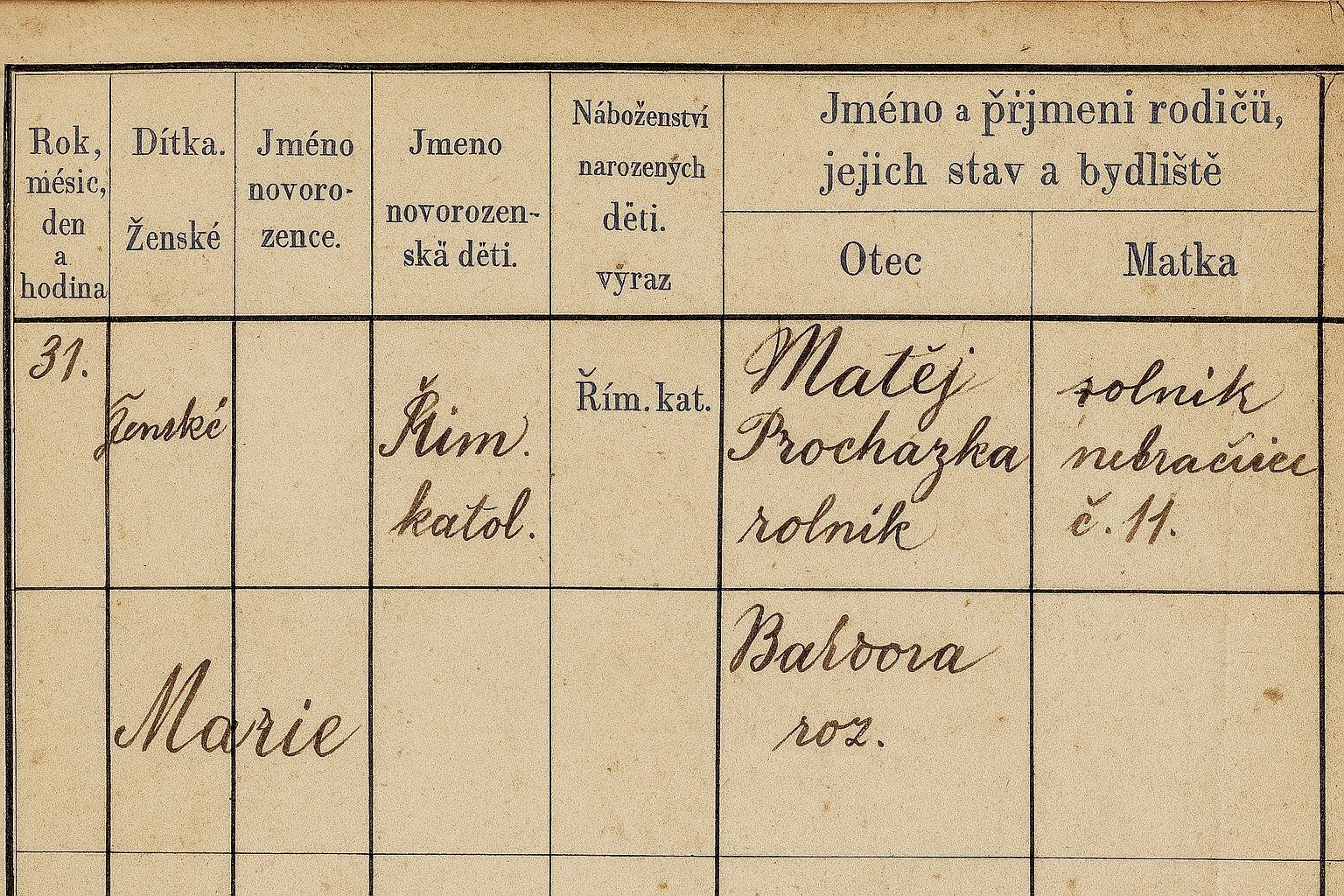
The second problem for AI lies in translating texts that are, in some way, unconventional. I’m talking old dusty yellowed archival materials, barely legible handwritten letters from the Second World War, or old registry records from the 18th century. AI simply isn’t up to those yet. Or rather — it will happily produce a translation of such documents, because confidence is something it certainly doesn’t lack! And if it happens not to be able to “read” something, it will just guess… or invent it. So be careful with it. Or her…or him?!
I couldn’t find a suitable image to go under this paragraph, so I asked AI to create an image of an old Czech birth register. It did quite a good job, but when you look more closely, you realise that not everything is quite as it should be…
I think this example perfectly illustrates our problem with AI. At first glance, artificial intelligence looks authentic and credible, but under closer inspection we start seeing the cracks. Can you tell what’s wrong? {Knowledge of Czech required, sorry :))
Always check your facts!
The third problem, following on from the previous one, is AI’s confidence. It will answer any question you ask it, translate whatever you need, create whatever you request. And most of the time it does so in a way that leaves you with no doubt that it is an absolute expert in the field. In all fields! Of course, I use AI in my own practice — I’m not a dinosaur working with pen and paper (although my kids definitely think I am). But I approach it with caution and don’t blindly accept everything it spits out at me. Always check your facts!
It won’t be long (five years, ten?) before artificial intelligence is able to handle translations better than humans — I have no doubt about that. At that point, nobody will probably need me for general translations anymore, and I’ll focus on certified ones — until AI conquers that sector too, but by then I’ll hopefully be retired 🙂 Until that happens, however, you can continue to turn to me with requests for translations of all kinds, with or without a stamp.